


Car Parking Options at Manchester Airport
-

Manchester Car Parks score on average 96% based on 55431 customer reviews.
-
Our customers review the car parks they booked through us. We display the feedback for all to see on our results page.

-
PLUS: SkyParkSecure’s price check promise always guarantees the best price for a wide range of parking operators.

 As an accredited supplier of Official Manchester Airport Parking, SkyParkSecure offer an excellent selection of both official Parking at Manchester Airport and off-site car parks to suit every traveller's exact needs.
Whether you’re flying from Manchester Terminal 1, Terminal 2 or Terminal 3, SkyParkSecure can help to find you convenient parking near Manchester Airport.
FREE CANCELLATION COVER*
Free Cancellation Cover (normally £1.49) does not apply for bookings made the same day, booked for the following day or in certain products where stated.
Cheap Parking At Manchester Airport
Cheapest parking product - JetParks Ringway - Official Airport Parking
Park for as little as £4.53 a day!
Compare Cheapest Manchester Airport Parking optionsFor the cheapest parking prices at Manchester Airport, be sure to pre-book before your trip to get the best possible deal. Check out some of the cheapest parking options for 4 and 8-day stays. Our products are reviewed by real customers using a third-party independent review system. |
|||||
|---|---|---|---|---|---|
| MAN Car Parks | 4-Day Stay | 8-Day Stay | Review Rating /5* | ||
| Official Airport Drop & Go | N/A | £50.99 | 4.7 | ||
| JetParks Ringway - Official Airport Parking | N/A | £44.99 | 4.2 | ||
| Official Airport Meet & Greet - T2 | N/A | £67.99 | 4.7 | ||
| Hunters Park and Ride | £40.00 | £50.00 | 4.8 | ||
| Toad Park & Ride | £37.45 | £51.45 | 4.6 | ||
| NCP Flightpath - Park & Ride | £40.50 | £57.75 | 4.5 | ||
| Official Airport MidStay - T1 & T3 | £51.99 | £69.99 | 4.3 | ||
| Official Airport Meet & Greet - T3 | N/A | £69.99 | 4.7 | ||
| Official Airport Meet & Greet - T1 | N/A | £69.99 | 4.7 | ||
| Official Airport T3 Multi-Storey | £59.00 | £71.00 | 4.4 | ||
| Official Airport T1 Multi-Storey | £59.00 | £75.00 | 4.6 | ||
| Airport Parking - Park & Ride | £55.60 | £76.80 | 4.7 | ||
MANCHESTER OFF-AIRPORT PARKING PACKAGES

SkyParkSecure has a range of off-airport car parking options available. These options allow you to avoid the stress of finding a place to stop and getting to the busy terminal forecourt by including a short bus ride.
Below are a variety of different cheap off-airport parking options for Manchester Airport. There is an average distance from the airport included in the information provided, alongside independent reviews from real customers. By including this information, you are always guaranteed to find an option suitable for your needs.
Compare Park and Ride at Manchester Airport



MANCHESTER MEET AND GREET CHEAP PARKING PACKAGES

The table below includes a variety of different meet and greet options available at Manchester Airport. SkyParkSecure has both official Meet and Greet for the airport as well as approved off-airport providers. These Meet and Greet options allow you to drop your vehicle right at the terminal, where a driver can park your car for you and allow you to check in for your flight on time. This ensures you avoid any delays getting to the terminal.
SkyParkSecure can appeal to every budget by offering both official and off-site car parks and the added use of customer rating allows you to choose the best options available at Manchester Airport.
MANCHESTER ON-AIRPORT PARKING PACKAGES

By choosing a cheap on-airport car park option with SkyParkSecure, you can avoid the stress of travelling to and from the terminal. Customer ratings for cheap on-airport Manchester parking can be found below in the parking options table, meaning you can choose a car park suitable for your needs.
Official on-site car parks at Manchester airport eliminate the need for a bus transfer and these car parks service all terminals at Manchester airport. Simply park in an available space and walk to the terminal from the car park. Customer ratings for each car park option can also be found below so you can make an informed decision on your airport parking choice.
OFFICIAL ON-SITE MAN AIRPORT PARKING


LIVE DEPARTURE UPDATES FOR
MANCHESTER AIRPORT
If you need to find out your Manchester departing terminal or the latest status information for flights, you can check your flight on the Manchester Airport live status board.

MANCHESTER AIRPORT SECURITY,
BAGGAGE & LIQUIDS
If you are unsure of what the Manchester security controls are, and what you can or can't take on the aircraft, then please refer to the detailed instructions provided by Manchester Airport security.
Available Manchester Parking Services
Manchester Airport, one of the busiest airports in the UK, sees a diverse array of passengers, from business travellers to holidaymakers, so Manchester parking could be a bit hectic without SkyParkSecure on your side. But no matter why you’re flying, we can offer you a wide range of car parking options to suit your needs.
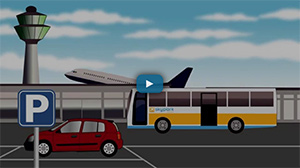
Normally the most cost-effective parking package, simply park your car in one of the secure car parks and hop on one of the many...
Read More
If you want to get seriously close to Manchester Airport, these are the parking spaces for you! Park your car onsite by the airport terminal and walk straight in — no messing around!...
Read More
Let someone else do the hard work of finding a parking space with this valet parking option. Simply arrive at your Manchester Airport Terminal and leave your car with a fully insured chauffeur who’ll park your car for you....
Read MoreHow to Get to Manchester Airport
All three Manchester Airport terminals are easily accessible from Junction 5 of the M56 motorway.
From the North
Join the M61 from the M6 and then merge onto the M60. Exit the M60 at Junction 5 for the M56.
From the South
Join the M56 at Junction 19 of the M6.
From the East
Exit the M60 at Junction 1 for the M56.
From the West
Take either the M56 and exit at Junction 5, or join the M56 from the M6 at either Junction 19 or 20.
Sat Nav Information
Postcode: M90 1QX
Latitude: N53:21:14 (53.361881) Longitude: W002:16:30 (-2.270840)
Train to Manchester Airport
The MAN train station can be reached from Manchester Piccadilly - and vice versa – in around 20 minutes. Services run every 10 minutes to and from MAN airport, so connections from Manchester city centre are straightforward.
Once at MAN airport train station, there is a 10-minute walk to the MAN departure terminals.
Tram to Manchester Airport
The Manchester Metrolink tram service takes approximately 35 minutes to get from Manchester city centre via Cornbrook station to MAN airport. You must buy a ticket on the platform in advance to boarding the Metrolink tram.
Bus to Manchester Airport
There a several regular bus and coach services from the local areas and beyond to MAN airport bus station. As is the case for travellers arriving by train or tram, The Station at Manchester airport is the drop-off point for all bus or coach riders and the airport is reachable in a 10-minute walk from there. Services run up to every 20 minutes in some cases. You can check the timetables here.
Find timetables and plan your journey with the public transport journey planner
Official Short Stay Parking at Manchester Airport
The Manchester on-airport multi-storey car parks are ideal for short stays. Manchester Airport has three multi-storey onsite car parks, one right next to each terminal, saving a considerable amount of time on arrival and departure. Although there is a multi-storey assigned to each airport terminal, they are fairly convenient for all terminals.
All three on-airport multi-storey car parks have been given the Park Mark Award, offer secure parking, and benefit from regular patrols and CCTV monitoring.
Short Stay Parking - Terminal 1
Short Stay Parking - Terminal 2
Short Stay Parking - Terminal 3
Official Long Stay Parking at Manchester Airport
For longer stay parking spaces, Manchester Airport has two long stay car parks, both of which have been given the Park Mark Award and offer secure parking.
Although they are within walking distance to their associated terminals, a transfer bus runs every 10 minutes and takes only five minutes.
Manchester Airport Terminal 1 & 3 Long Stay Car Park
Manchester Airport Terminal 2 Long Stay Car Park
Official Park and Ride at Manchester Airport
Park and ride is usually the cheapest car parking option at Manchester Airport. Simply park your car at your chosen car park and catch the regular shuttle bus to your terminal.
JetParks is the official Manchester Airport Park and Ride parking service and there are four JetParks car parks at the airport.
JetParks 1 and JetParks 2 are the closest to Terminals 1 and 2 and take 5–10 minutes by shuttle bus, while JetParks 3 is the closest to Terminal 3 and takes 10–15 minutes. The latest park and ride parking option is JetParks Ringway, which is located just around the corner on Shadowmoss Road.
All the JetParks car parks offer secure airport parking and each one has been given the Park Mark Award.
The car parks are patrolled 24 hours a day and protected by CCTV, barriers and fencing. They are also DDA (Disability Discrimination Act) compliant and disabled customers are able to park in suitable places. The complimentary shuttle buses are also wheelchair friendly.
JetParks 1 Park and Ride Manchester
JetParks 2 Park and Ride Manchester
JetParks 3 Park and Ride Manchester
JetParks Ringway Park and Ride
The SkyParkSecure Price Check Promise
The bonus of booking Manchester Airport parking through SkyParkSecure.com is that you’ll always pay the cheapest price. We guarantee to give you a lower price than our competitors with our Price Check Promise.
Terms and Conditions
- The price check promise only applies to airport parking products.
- The product that you are comparing must be exactly the same as the one purchased from SkyParkSecure.
- You must make your claim within 24 hours of making and paying for your booking with SkyParkSecure.
- Successful claims will not be paid until after the return date originally booked.
- Cancellation of the booking cancels your right to claim under this guarantee.
Price comparison excludes:
- Prices from other suppliers that are conditional on buying other products.
- Prices that are part of a customer loyalty, members or loyalty reward scheme.
- Prices that are part of a staff discount scheme.
- Prices that are part of any other discount or special offer deal.
Manchester Airport Duty Free
The Rules on Duty Free:
You can bring some goods from abroad without having to pay UK tax or ‘duty’ (customs charges), as long as they’re for your own use.
If you’re coming:
- from a European Union (EU) country you can bring in an unlimited amount of most goods
- from outside the EU you can only bring in a certain amount without paying duty or tax - up to your duty-free allowance
Manchester airport duty free shops
Duty free is available on Fragrances, Makeup, Skincare, Suncare & Tanning, Sunglasses, WInes & Spirits, Technology.
Top Tips and Trick for Manchester airport Duty Free
1. Browse and reserve online - MAN airport has a dedicated Duty Free website
Your order will be awaiting collection in the store you reserved from e.g. Dixons or World Duty Free after security.
2. Buying non-travel items cheaper
If you are travelling within the EU or UK you do not want to take your pre-order purchases with you on your travels, simply make use of the Collect on Return service. This can be done by selecting the Collect ON Return service or even by speaking to a member of staff at the till in the Duty Free store.
3. Have your duty free items delivered to you
If you purchase from Dixons Travel, you can have your purchases delivered to your home address after you return. Again a perfect option if you want to take advantage of the great prices but don’t need your new purchase with you on your trip.
Manchester Airport Restaurants
Looking for places to eat at manchester airport? We have compiled a tasty list for you to consider.
Terminal 1 MAN airport restaurants
The Grain Loft
Open from 6 am till 4 am the following day. Tables of 6 or more can be pre-book in advance by calling 0161 489 3416.
A favourite by many is the 'Protein Power Breakfast', which is essentially an all-day breakfast without the toast.
Table booths feature sound pods that you can collect your music to. Also, all major sporting events are shown live.
Food menu
Breakfast menu
Kids' menu
Drinks menu
Bar MCR
Opening times are dependant on the first and last departing flight from Manchester airport.
Tables include plug sockets so you can charge those devices whilst eating, drinking and watching the planes go by.
The all-day day breakfast here is priced at £7.45. For those wanting a touch of Manchester Northern quarter, there is also the option of smashed avo on toast.
Breakfast menu
Main menu
Drinks menu
Café Balzar
Opening times are again dependant on the first and last departing flight from Manchester airport.
Sadly no all-day breakfast here, instead there is the option of an egg white omelette (£7.85) for those wanting that high protein hit.
Breakfast menu
Main menu
Kids menu
Drinks menu
Frequently Asked Questions
See below for our most commonly asked questions. If you'd like to ask anything else, please contact us directly.
How much is parking at Manchester Airport?
Prices can vary on a daily basis, so it is always best to get a quote to find out accurate prices for parking. Our prices are up to 70% cheaper than the gate price so you will make a huge saving by booking in advance. You also have the peace of mind that a space is reserved for you.
What is the best parking at Manchester Airport?
You can choose between all of the available car parks at the Airport by entering your dates into the quote form at the top of the page. You can also view independent reviews of the car park, collected from genuine customers be the independent review service Reevoo, so that you can get a clearer picture of the car parks before you book.
Is there free parking at Manchester Airport?
If you’re dropping someone off at the airport, you can do so for free at the free drop off point. The free drop off point is on Thorley Lane, next to the JetParks 1 car park and clearly signposted from the M56. From here, passengers will be able to take a free and frequent shuttle bus to their terminal.
If you want to drop passengers off directly outside their terminal or at the Station, a charge will apply. The fee for this is £3 for five minutes and £4 for 10 minutes. Special arrangements apply for Blue Badge holders, local residents and Private Hire operators.
If you’re picking someone up from the airport, please park in the Arrivals car park (for Terminal 1 and Terminal 3) or in the Multi-Storey car park (all terminals).
Can you leave your car at Manchester Airport?
Yes you can. We offer several car parks that are based within moments of the terminals, so you won't have far to go. Depending on your terminal, options include Multi Storey car parks, Meet and Greet's and car parks that require shuttle services to get to the terminal.
Can you just turn up at Manchester Airport and Park?
You can turn up and park, paying the gate price at Manchester Airport if the car park have spaces available. Alternatively, you can pre-book, and know that your car parking space has been reserved for you, and you have saved up to 70% off the gate price by pre-booking.
Can I use a discount code for parking at MAN airport?
SkyParkSecure have a variety of different discount codes for you to use on your Manchester Airport parking. Our discount page is the place to get the best discounts for parking at MAN airport.

THE PARK MARK SAFER
PARKING SCHEME
Park Mark is a national standard for UK car parks. It shows they have low crime and measures to ensure the safety of customers and their vehicles. Make sure your Manchester Airport car park or meet and greet service meets the required standards.

HELP & SUPPORT FOR MANCHESTER
AIRPORT PARKING
Helpful links and tips for Manchester Airport parking

MANCHESTER AIRPORT HOTELS WITH PARKING
Relax the night before your flight from Manchester

MANCHESTER AIRPORT LOUNGES
Escape the rush by enjoying an airport lounge inside Manchester Airport.

INTERNATIONAL
CAR HIRE
Compare the prices for car hire

SKYPARKSECURE CUSTOMER SERVICE
SkyParkSecure rated 94% on independent review site Reevoo. All bookings supported by our Price Check Promise. Bookings and Enquiries 0808 168 6111